

Fellowship Overview
Description
The Abdominal Organ Transplant Fellowship at the University of Toronto is a 2-year clinical training program in transplantation offered by the G.I. Transplant Program of the Multi-Organ Transplant Program, and the Division of General Surgery in the Department of Surgery at the University of Toronto.
It consists of a first clinical “core” year in Transplantation and HPB Surgery followed by a second year in Abdominal Organ Transplantation (liver, pancreas, small intestine and kidney) and associated research. The Abdominal Organ Transplant Fellowship is offered to two individuals every year.
This Fellowship operates within the Department of Surgery, University of Toronto and within the guidelines outlined in the Task Force on Clinical Fellows document.
The aim of the Abdominal Organ Transplant Fellowship is develop outstanding, academic Transplant Surgeons. We provide the trainee with the basic and clinical education and the clinical experience necessary for that individual to become expert in the understanding, diagnosis, and management (including the necessary surgical skills) in the treatment of diseases of the liver, biliary tract and pancreas and for that individual to be a competent, academic Abdominal Organ Transplant and Hepato-Pancreato-Biliary Surgeon. Clinical and/or translational research productivity is a vital component of the Fellowship.
Toronto has become a very large transplant program in North America, performing yearly more than 200 liver transplants, 45 pancreas transplants and 150 kidney transplants. Our live donor liver transplant program is recognized as the premier program in the west with over 45 adult and 15 paediatric liver transplants performed each year. The Toronto case volumes also allow us to offer excellent training in pancreas transplant, paediatric liver (live & deceased donor), NDD and DCD organ procurement, laparoscopic donor nephrectomy and live donor kidney transplant and vascular access. Through integration with HPB Surgical Oncology Fellowship Program, the Transplant Fellow is also trained in complex HPB Surgery. At any one time there are 6 to 8 Fellows in Transplant and HPB Surgery making Toronto a large Fellowship program.
The Fellows work with 10 Transplant and HPB Surgical Oncology staff surgeons: Drs. Ghanekar, McGilvary, Moulton, Reichman, Sayed, Goldaracena, Selzner & Shwaartz.
Fellows are expected to transition to independent operating during their Fellowship. It is anticipated that each Fellow should be capable of independent deceased donor procurement (liver, pancreas and kidney) by the 3rd or 4th month of the first year. Independence in adult liver, pancreas and kidney transplantation is expected by mid-second year.

HPB and Transplant Fellows 2025-2026
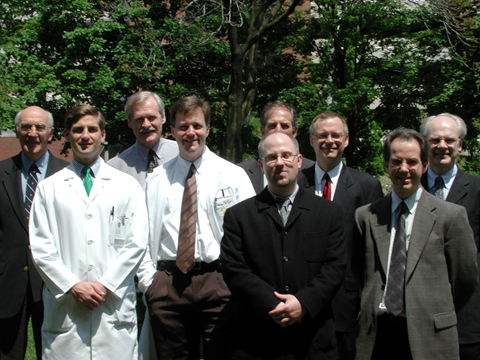
Transplant & HPB Fellows, 2002.
The Role of the University of Toronto
Clinical fellows play a significant role in our healthcare system, and the University of Toronto is a leading institution in the training of clinical fellows. According to the most recent data of the Canadian Post MD Education Registry (CAPER), 68% of all the clinical fellows in Ontario and 47% of all the clinical fellows in Canada are registered at the University of Toronto. This share of the total provincial and national clinical fellowship enrolment has belonged to the University of Toronto since 2007.
Clinical fellowship education involves the participation of numerous, and varied, stakeholders. To ensure the widest possible understanding of the University of Toronto’s role in the advanced postgraduate medical training of these doctors, the University has prepared concise documentation outlining the role of the University in Fellowship Training. This item is directly accessible via the following web link: http://pg.postmd.utoronto.ca/?ddownload=4004
Rotations
First Year
During the first year, the Transplant and HPB Fellowships are integrated and each Fellow does deceased donor and transplant procedures, elective HPB Surgery and in-patient management, HPB & transplant clinics, and all transplant & HPB rounds, seminars and educational activities.
Transplant Surgery and Call
- Donor call: 1 in 5-6 throughout the year
- Liver recipient and MOT ward call: 1 in 5-6 throughout the year
- Pancreas/kidney call: 1 in 5-6 throughout the year
Note that Fellows’ call for donor, recipient, and MOT ward occurs throughout the year (usually 1 week for each, every month). This is in contra-distinction to a schedule of blocks (often 2-3 months) of pure donor call, liver call, pancreas call, and kidney call. This is ensure optimal exposure to donors and recipients throughout the year and avoid the inequity of a first year Fellow being assigned to liver transplant during the first three months, vs the last three months of the year.
HPB Elective Surgery and Call
- Three month rotations with one or two HPB Staff for their clinics and elective surgery
- Three month rotations on HPB in-patient service, without donor or recipient call, responsible for HPB emergencies (CBD injuries, ruptured adenomas etc.)
Second Year
During the second year, The Transplant Fellow continues deceased donor transplant activity and focuses on complex transplant activities:
- Liver re-transplants
- Live donor liver donor & transplantation
- Laparoscopic donor nephrectomy and live donor kidney transplant
- Pediatric liver transplant
- Multivisceral transplants
- The transplant clinics:
- Donor call: 1 in 5-6 throughout the year (usually none in the last 3 months)
- Liver recipient and ward call: 1 in 5-6 throughout the year
- Pancreas/kidney call: 1 in 5-6 throughout the year
- Research projects are identified and initiated during the first year and completed in the second year

HPB & Transplant Fellows 2025
PD : Dr.Chaya Shwaartz
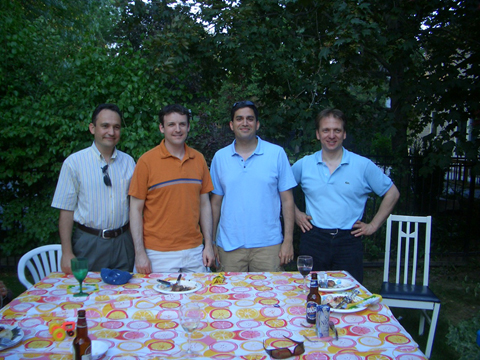
Transplant & HPB Fellows, 2006.

Transplant & HPB Fellows 2021-2023
Left to Right Drs.Pablo Achurra,Casey Ward,David Henault,Brian Ezekian,Farah Ladak,Toru Goto

Transplant & HPB Fellows 2023-2025
Left to Right : DrS: Ahmer Irfan,Pablo Achurra,Daniel Kilburn,Taylor Coe,Su Kah Goh,Farah Ladak
Curriculum & Didactic Teaching
For Transplant, our curriculum follows the ASTS Academic Universe. Fellows are required to complete the requisite modules as proscribed by the ASTS. For HPB, our curriculum follows the Fellowship Council’s Advanced GI Curriculum for Hepato-Pancreato-Biliary Surgery Fellowship. Fellows are required to contribute to the online myHPB cases discussions as proscribed by the AHPBA. The Toronto Video Atlas of Liver, Pancreas & Transplant Surgery has been developed specifically for Fellowship training. An extensive series of transplant and HPB cases has been developed for the Fellows integrating 3D reconstructions of anatomy, intraoperative videos and graphic overlays using a case-based teaching methodology.
The following regularly scheduled rounds, and conferences are held:
| Date | Frequency | Name | Mandatory |
|---|---|---|---|
| Monday 7-9am | weekly | Surgical Oncology Seminar Series | |
| Monday 4:30-5:30pm | weekly | General Surgery Quality Rounds | mandatory |
| Monday 6-8pm | monthly | HPB/Hepatology Faculty Club Series | |
| Tuesday 8-9am | weekly | Live Liver Donor Review | |
| Tuesday 4-5pm | weekly | Hepatoma Review Board | |
| Tuesday 5-6pm | weekly | GI Tumour Review Board | |
| Tuesday 6-9pm | quarterly | HPB Journal Club | mandatory |
| Wednesday 8-9am | weekly | Multi-Organ Transplant Rounds | |
| Wednesday 5-6pm | monthly | HPB Video Conference Grand Rounds | mandatory |
| Thursday 7-8am | weekly | Fellows Transplant Rounds | mandatory |
| Thursday 4-5pm | monthly | Transplant Quality Review | mandatory |
| Thursday 4:30-5:30pm | monthly | Teach Residents at HPB Seminars | mandatory |
| Thursday 6-9pm | quarterly | Transplant Journal Club | mandatory |
| Friday 7:30-8:30am | weekly | University or Hospital – Wide Rounds | |
| Friday 9-10am | weekly | Liver Transplant Listing Conference | |
| Friday 10-11am | weekly | HPB Clinical Research Rounds | mandatory |
| Friday 11-12pm | weekly | Professor Rounds: Case Review | mandatory |
| Friday 12-1pm | weekly | HPB Tumor Board/Multidisciplinary Cancer Conference | mandatory |
 The Toronto Video Atlas of Liver, Pancreas & Transplant Surgery (TVASurg)

The Toronto Video Atlas is a 3D-animation-enhanced surgical video atlas and is an important component of our transplant curriculum. The website is designed to instruct surgeons in the care of patients with complex problems in liver, pancreas and transplant surgery, and highlight the advanced surgical techniques required for the management of these diseases. The curriculum and cases have been targeted to surgeons who have completed their training in General Surgery and are enrolled in Fellowship training in liver, pancreas and transplant surgery. In each case the discussion regarding the pre-operative planning is enhanced by 3D reconstructions of the patient’s anatomy taken directly from the patient’s imaging, and the intraoperative video images are augmented with graphic overlays and 3D reconstructions to re-orient the viewer appropriately. The Atlas continues to grow with one new case added to the website each month. The Transplant Section contains donor and recipient procedures for both adult and pediatric recipients. Click here for an example of a live donor liver transplant. The website is publicly available.
Invited Professors
The following Invited Professors have been made possible through generous donations to the Transplant & HPB Fellowship programs at the University of Toronto.
The Mummenhoff Invited Professor in Transplantation
Dr. Jean Emond (2009)
Professor of Surgery, Columbia University; New York, New York
“Organ Allocation”
Dr. John Roberts (2012)
Professor of Surgery, University of California; San Francisco, California
“Live Donor Liver Transplantation”
Dr. William Chapman (2016)
Professor of Surgery, Washington University; St. Louis, Missouri
“Development of an Organ Donor Recovery Center”
Dr. Lucas McCormack (2017)
Professor of Surgery, Universidad de Buenos Aires; Argentina
“Liver Transplantation for HCC in Argentina: How can we make it better?”
The Feeney Invited Professor
Dr. William Jarnagin (2014)
Professor of Surgery, Memorial Sloan Kettering Cancer Center; New York, New York
“The Enigma of Gall Bladder Cancer”
Dr. Elijah Dixon (2015)
Associate Professor, University of Calgary; Calgary, Alberta
Clinical Trials & Tribulations”
Dr. Jen Jen Yeh (2017)
Associate Professor, University of North Carolina; Chapel Hill, North Carolina
“Deconstructing Pancreatic Cancer to Understand Tumour-Specific Signals”
Dr. Thomas A. Aloia (2018)
Associate Professor, M.D. Anderson Cancer Center; Huston, Texas
“Pursuit of the Perfect Hepatectomy”
Dr.Philip J. Devereaux ( 2024)
MD, PhD, FRCPC Professor, Departments of Health Research Methods, Evidence & Impact (HEI) & Medicine Director of the Division of Perioperative Care
Department of Surgery University Rounds: 2024 Ben Alman Lecture
“Advancing Clinical Trials and Achieving Excellence in Perioperative Research”
Dr.Craig R. Smith (2025)
MD, Professor & Chair, Department of Surgery, New York Presbyterian Hospital and Columbia University
The Department of Surgery November 2025 University Rounds: W.G. Bigelow Lecture
“A Brief History of Once and Future Things”
The Charbonneau Invited Professor
Dr. Jean Nicolas Vauthey (2013)
Professor of Surgery, M.D. Anderson Cancer Center; Houston, Texas
“Colorectal Liver Metastases”
Dr. Rebecca Minter (2015)
Associate Professor, University of Michigan; Ann Arbor, Michigan
“Can I trust you to do my whipple?”
Dr. Alan Hemming (2017)
Professor of Surgery, University of California; San Diego, California
“Extending the Limits of Liver Surgery: Can this high-risk surgery be justified?”
Dr. Daniel Cherqui (2018)
Professor of Surgery, Université Paris Sud; Paris, France
“Laparoscopic Liver Surgery: How far have we reached?”
The Rogan Invited Professor
Dr. Robert Padbury (2013)
Professor of Surgery, University of Adelaide; Adelaide, Australia
“Quality in HPB Surgery”
Dr. Nicolas O’Rourke (2012)
Professor of Surgery, University of Queensland; Brisbane, Australia
“Laparoscopic HPB Surgery”
The John Palmer Lecture (University of Toronto)
Dr. Mike Choti (2012)
Professor of Surgery, Johns Hopkins School of Medicine; Baltimore, Maryland
“Image-Guided Liver Surgery: Current Status and Future Directions”
Dr. Tim Pawlik (2015)
Professor of Surgery, Johns Hopkins School of Medicine; Baltimore, Maryland
Dr. David Kooby (2016)
Professor of Surgery, Emory University School of Medicine; Atlanta, Georgia
“Minimally Invasive Pancreatic Resection: Where We Are and Where We Need to Go”
Dr. Dmitry Oleynikov (2018)
Professor Chief of GI/MIS, University of Nebraska; Lincoln, NE
“The Future of Surgery is Robots”
Dr. Dave R. Williams (2019)
MD, President and CEO, Exploration Incorporated; Montreal, QC
“Perspectives on Surgery and Spaceflight”
Dr. Vincenzo Mazzaferro ( 2021)
Professor of Surgery, University of Milan, Italy Director of the Gastro-Intestinal Surgery and Liver Transplantation Unit Fondazione IRCCS Istituto Nazionale dei Tumori, Milan, Italy
“Modern Approach to Liver Transplantation for Cancer”
Dr. Husein Moloo ( 2023)
MD, MSc, MPH, FRCSC- Director, Planetary Health, Faculty of Medicine, University of Ottawa
“Planetary Health: How can surgeons help save the planet?”
Dr.Rebecca M. Minter ( 2025)
MD, MBA,A.R. Curreri Professor Chair, Department of Surgery, University of Wisconsin School of Medicine & Public Health
“Entrustment and Entrustability– Training the Next Generation of Surgeons”
Dr. Richard Reznick ( 2024)
OC,MD,FRCSC,FACS,FRCSEd (hon), FRCSI(hon), FRCS(hon) Professor Emeritus of Surgery & Dean Emeritus, Queen’s University Immediate Past President, Royal College of Physicians and Surgeons of Canada
“Delivering on the promise of simulation-based surgical education…On the Edge of a Dream”
Dr.Insoo Suh (2026)
Professor, Surgery & Vice Chair, Surgical Innovation, NYU Grossman School of Medicine
Clinical Faculty Lead, NYU Technology Opportunities & Ventures
Chief of Endocrine Surgery, NYC Health+ Hospitals/Bellevue
“Education in sugical innovation : Can we do it? Should we?”